
The Sound of Ka, Kha, Ga, Nga
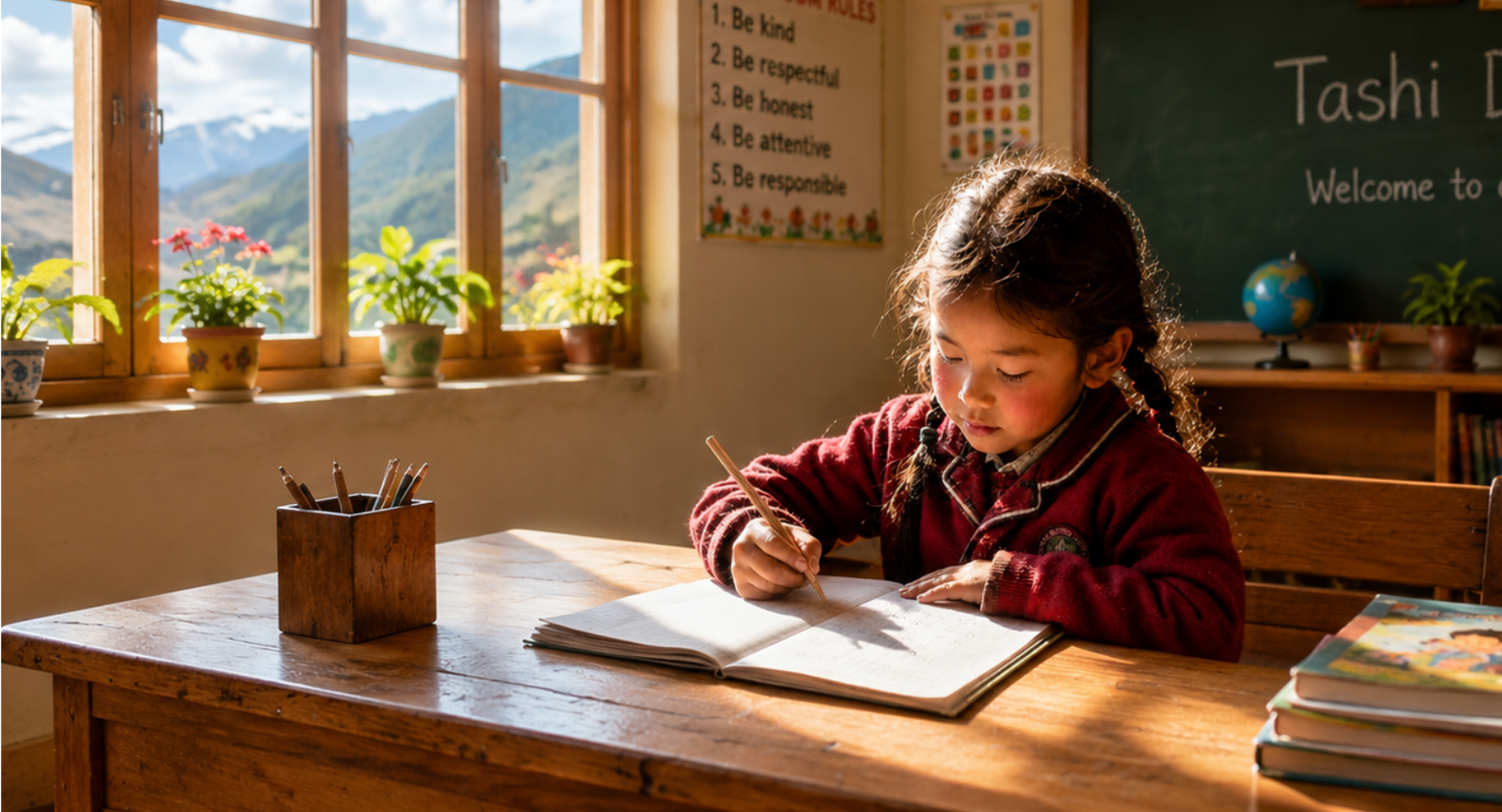
In a small classroom, a five-year-old girl in a school uniform holds a wooden pencil and copies four letters into her notebook.
Ka. Kha. Ga. Nga.
Her teacher writes them on the blackboard in beautiful Uchen script. Outside the window, prayer flags move softly in the wind. The classroom is quiet, but something ancient is alive in that moment.
These are the first four letters of the Tibetan alphabet.
They are the same four letters that a young man named Thonmi Sambhota brought home to Tibet from India more than 1,300 years ago. The same letters that monks have whispered in monasteries, that mothers have sung to babies in nomad tents, that pilgrims have carved into mountain stones for over a thousand years.
And today, those four letters are asking us to carry them forward.
This is a story about why the Tibetan language matters. But more than that, it is a story about memory, love, family, and hope.
Because every time a child writes Ka, Kha, Ga, Nga, something precious continues.
How Tibetan Became a Written Language
Imagine Tibet in the year 632. A young, ambitious king named Songtsen Gampo rules a vast empire from Lhasa. He has heard about a powerful new religion called Buddhism, with sacred books written in beautiful Indian scripts. He wants to translate those books into Tibetan. But there is a problem Tibet has no written language yet.
So the king sends his brightest minister, a young man named Thonmi Sambhota, on a long, dangerous journey across the Himalayas to India. Sambhota studies for years. He learns Sanskrit. He looks at Indian scripts and finds the one that fits the sounds of his own language best. Then he comes home, sits in retreat in a palace in Lhasa, and designs a new alphabet for Tibet.
Thirty consonants. Four vowel marks.
Simple in appearance, but powerful enough to carry an entire civilization.
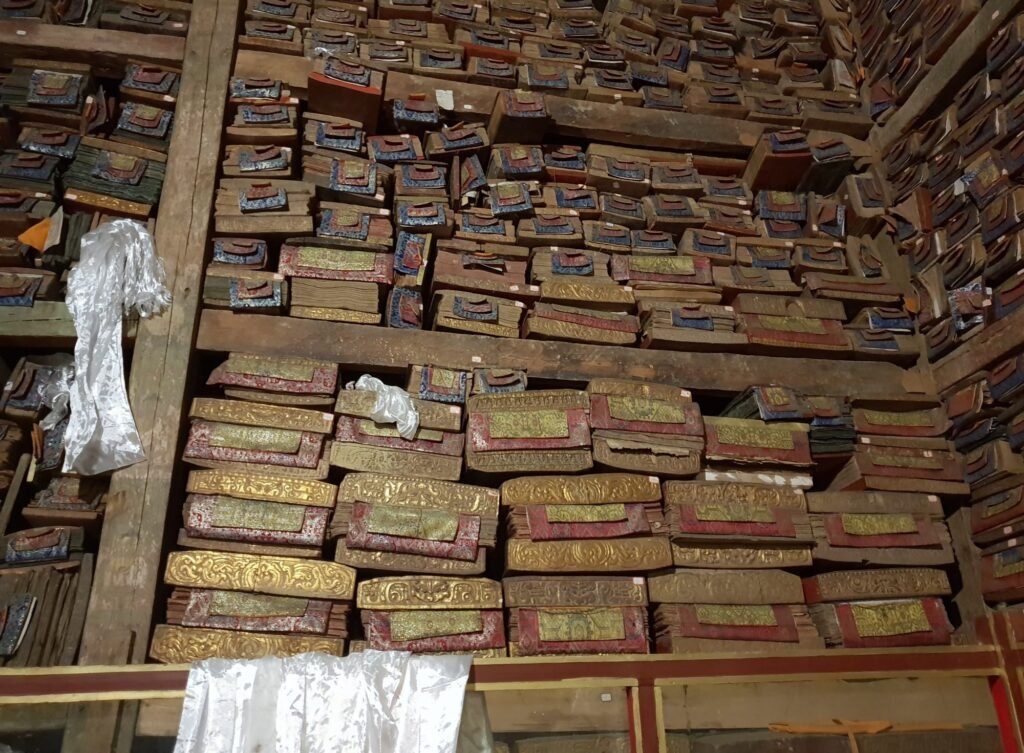
From that time onward, Tibetan became more than a spoken language. It became a written home for religion, medicine, poetry, history, philosophy, songs, prayers, and daily life.
The letters were no longer only marks on a page. They became vessels of memory.
A Language That Carries a Civilization
To understand why Tibetan matters, we have to understand what it carries.
Tibetan is not only a way to speak. It is a way to remember.
It carries Buddhist teachings, traditional medicine, old songs, mountain stories, family prayers, proverbs, jokes, blessings, and the soft everyday words spoken between parents, children, and grandparents.
Some Tibetan words are difficult to translate fully into another language.
Bodhicitta is not just compassion. It is the awakened heart.
Tonglen is not just meditation. It is the practice of taking and giving.
Tendrel is not just connection. It is the deep interdependence of all things.
Lungta is not only a prayer flag or wind horse. It carries energy, fortune, movement, and blessing.
When we lose a language, we do not only lose words.
“We lose a way of feeling. We lose a way of praying. We lose a way of understanding the world.“
That is why preserving Tibetan is not only about the past. It is about the future.
When a Language Becomes Quiet
A language does not disappear in one day.
It becomes quiet slowly.
It becomes quiet when children understand their grandparents but cannot answer them. It becomes quiet when old songs are remembered only by the older generation. It becomes quiet when parents are busy, children are in school, families move to new countries, and daily life begins to happen in another language.
Many young Tibetans around the world grow up speaking German, English, French, Hindi, Nepali, or another language more easily than Tibetan.
They may love Losar.
They may love momos.
They may wear chuba at community gatherings.
They may feel deeply Tibetan in their hearts.
But sometimes the language does not come easily.
And this is where we must be gentle.
We should not make young people feel ashamed because they cannot speak perfect Tibetan. Shame does not save a language. Love does.
“A language returns when it is welcomed. A language grows when it is used with patience. A language lives when children hear it without fear.“
Even one Tibetan word spoken at home can become a beginning.
Ama. Pala. Tashi Delek. Thuk je che.
Small words can open big doors.
The Home Is the First School
The first Tibetan school is not always a classroom.
Sometimes it is a kitchen.
It is a grandmother telling a story while making tea. It is a father calling his child by a Tibetan nickname. It is a mother singing a song she learned when she was young. It is a family saying Tashi Delek instead of only hello.
Children do not need perfect lessons every day. They need to hear the language living around them.
They need to hear Tibetan when someone is happy.
They need to hear Tibetan when someone is cooking.
They need to hear Tibetan during prayer, laughter, festivals, and ordinary family moments.
“Because language is not only learned from books.“
It is absorbed through love.
If a child hears Tibetan at home, even mixed with another language, something remains. A sound stays in the heart. A word becomes familiar. A sentence becomes less distant.
And slowly, the language becomes part of them.
The Young Generation and the Future
The future of Tibetan language does not belong only to scholars, teachers, monks, or institutions.
It belongs to children.
It belongs to teenagers typing Tibetan greetings on their phones. It belongs to young singers carrying Tibetan songs onto modern stages. It belongs to students attending weekend classes. It belongs to families trying again, even if the language is not perfect.
Many young Tibetans today live far from the land of their ancestors. They are growing up in Zurich, New York, Toronto, Sydney, Delhi, Kathmandu, Paris, London, and many other places.
Their world is modern, fast, and multilingual.
But this can also be a strength.
A young Tibetan today can speak German at school, English online, and Tibetan at home. They can listen to Tibetan music on a smartphone. They can learn Uchen script through online classes. They can record their grandparents’ stories. They can post Tibetan words on social media. They can make the language visible again in new ways.
The question is not whether young Tibetans can become exactly like the older generation.
They cannot, and they do not need to.
The real question is: can they carry the language forward in their own way?
Yes, they can.
What We Can Do
Preserving Tibetan does not have to begin with something big.
It can begin with one word.
Speak one Tibetan word every day. Teach a child how to say thank you. Ask your parents or grandparents to tell you one story. Write your name in Tibetan. Learn the alphabet slowly. Listen to Tibetan songs. Attend community events. Support Tibetan classes. Encourage children when they try, even if they make mistakes.
Do not laugh when someone speaks broken Tibetan.
Answer with kindness.
Every learner needs courage. Every young person who tries to speak Tibetan is doing something beautiful.
We can also keep the language alive through culture.
Through music.
Through storytelling.
Through festivals.
Through books.
Through prayer.
Through food.
Through community gatherings.
Through websites, blogs, videos, and social media.
A language survives when it is used in daily life.
Not only on special days.
Not only in ceremonies.
Not only in old books.
It survives when it is spoken at the dinner table, written in a message, sung in a song, and passed from one generation to the next.
A Language Is a Home
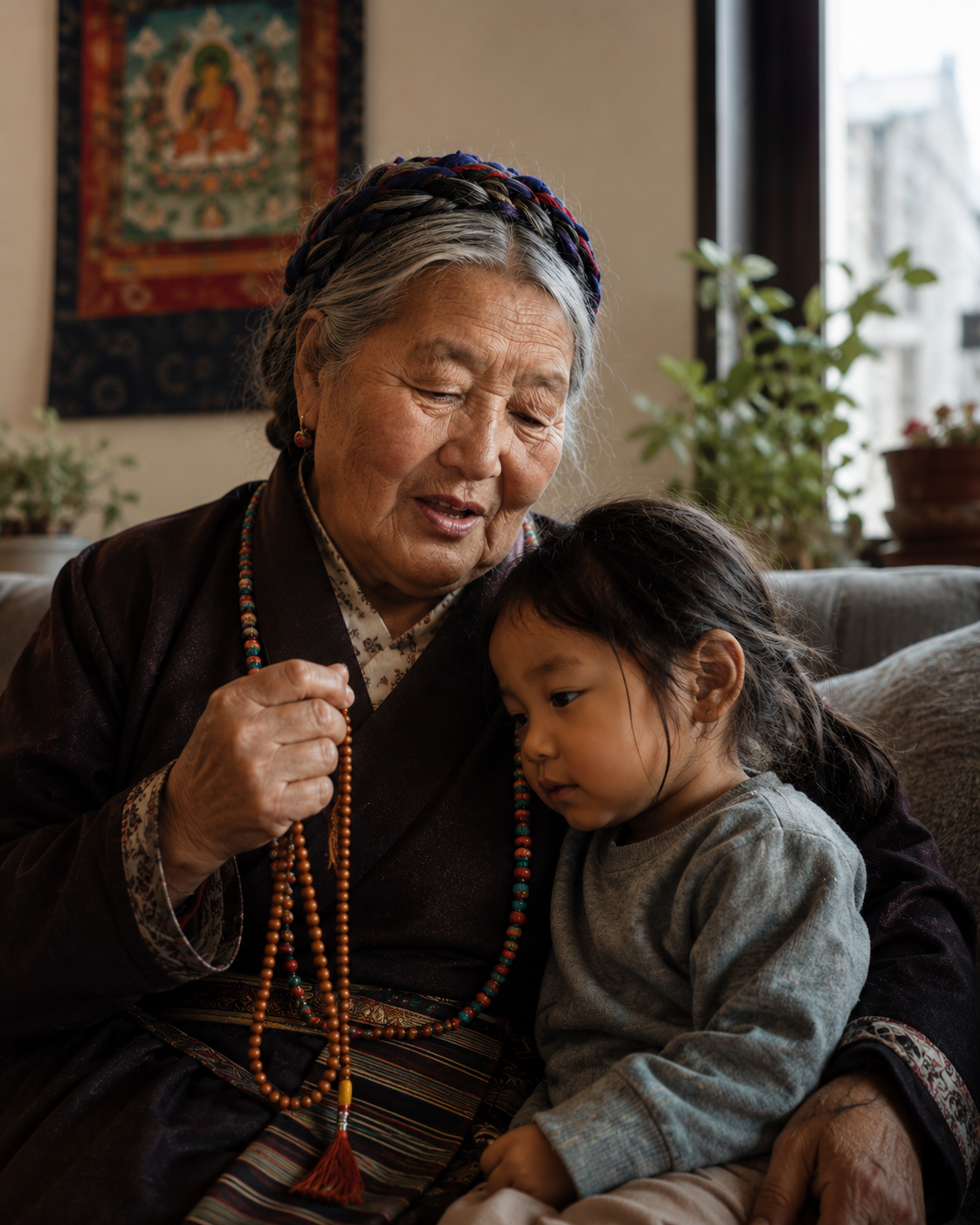
A language is more than grammar. It is a home.
It is the sound of your grandmother’s voice. It is the way your parents bless you. It is the song that makes elders close their eyes. It is the prayer carried by the wind. It is the word that cannot be fully translated, but can still be felt.
For Tibetans, the language carries memory.
It carries the mountains.
It carries the monasteries.
It carries the nomad songs.
It carries the stories told beside the fire.
It carries the kindness of elders.
It carries the wisdom of many generations.
To keep Tibetan alive is not only to protect a language.
It is to keep a people connected.
The Promise of Ka, Kha, Ga, Nga
So let us return to the little girl in the classroom.
She is still writing.
Ka. Kha. Ga. Nga.
Maybe she does not yet know the full history of those letters. Maybe she does not know the names of the kings, translators, poets, doctors, monks, singers, teachers, and grandmothers who carried this language before her.
But every careful line she draws is an act of memory, an act of love, and a promise to the future.
A promise that Tibetan will not live only in old books.
A promise that it will still be spoken at kitchen tables.
A promise that it will still be sung in children’s songs.
A promise that it will still be written in notebooks, typed on phones, and heard at community gatherings around the world.
“A language lives when people use it with love.“
And as long as one child writes Ka, Kha, Ga, Nga, the story is not finished.
It is beginnig again…….
By
Tenzin Palkyi
(more then 30 years of teaching experience)