
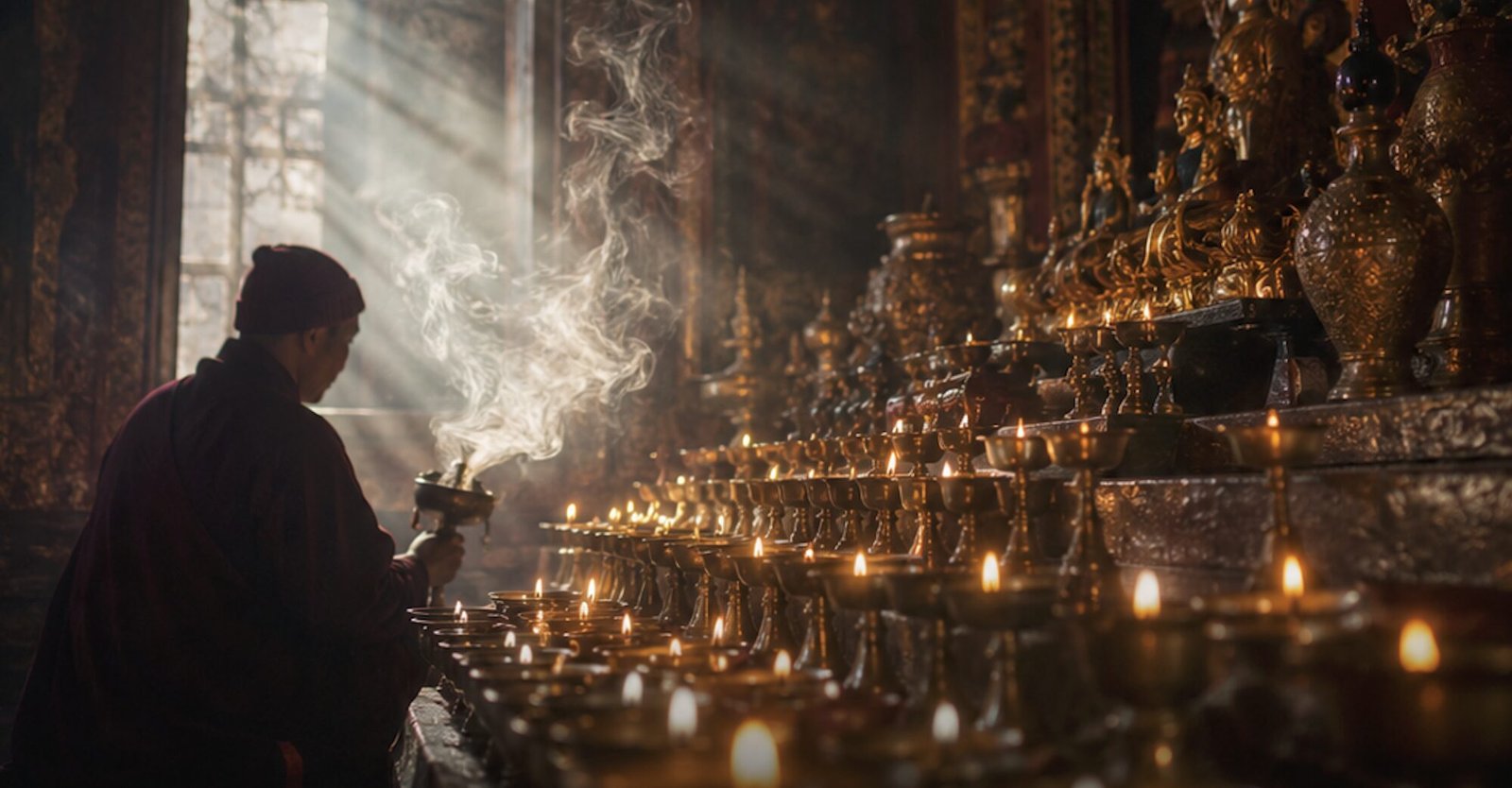
The Lamp Before Sunrise
I remember the smell first.
Butter. Warm, slightly sweet, mixed with juniper smoke drifting up from the offering bowl. My grandmother would be awake before any of us, kneeling in front of the small altar in our living room, lighting the butter lamps one by one. Her lips moved without sound. She did not need to read the words. She had been saying them for sixty years.
It was Saka Dawa, the holiest month of our year. And in our family, like in millions of Tibetan families around the world, the month began quietly with a flame and a whisper.
The Month That Changed Everything
Tibetans call it Saka Dawa, the month of the Saka star. It is the fourth month of the Tibetan lunar calendar and one of the most sacred periods in Tibetan Buddhism. In 2026, Saka Dawa begins on May 17 and ends on June 15. The most important day, Saka Dawa Düchen, falls on May 31, 2026.
But for us, these dates are not only calendar dates. They carry a deeper memory.
On this full moon day, Tibetans remember three great moments in the life of the Buddha: his birth, his enlightenment, and his passing into Parinirvana.
One moon. One day. One complete story.
A prince left his palace, searched for the truth, awakened beneath a tree, and spent the rest of his life teaching others how to free themselves from suffering.
That is why we celebrate Saka Dawa. Not only because it is tradition, but because it reminds us that awakening is possible.
A Month of Greater Awareness
When I was young, my grandmother told me something I never forgot.
“Tenzin,” she said, “every good thing you do during this month becomes much greater.”
At first, I thought it was only something adults told children. Later, I understood that there was a teaching behind her words.
During Saka Dawa, especially on the full moon day, Tibetans believe that the effect of our actions becomes much stronger. A kind word, a prayer, a donation, saving a life, or helping someone in need carries special meaning.
The same is also true for harmful actions. Anger, cruelty, harsh words, and careless behaviour are things we try to avoid even more during this month.
That is why many Tibetan families become quieter during Saka Dawa. We try to eat vegetarian food, give more generously, pray more often, and live with more care.
Saka Dawa is not only about belief. It is an invitation to live with more compassion.
Kora: The Walking Prayer
Ask any Tibetan what people do during Saka Dawa, and sooner or later, the word kora will appear.
Kora means walking clockwise around a sacred place, such as a monastery, stupa, temple, mountain, or lake.
From the outside, it may look simple. People walk slowly. Some turn prayer wheels. Some recite mantras. Some walk in silence.
But kora is more than walking. It is the body becoming a prayer.
Each step becomes an offering. Each round becomes a reminder that the path matters as much as the destination.
In Lhasa, pilgrims walk around the Jokhang Temple before sunrise. In Kathmandu, people circle the great white stupa of Boudhanath. In Dharamsala, the kora path above His Holiness the Dalai Lama’s residence is covered with prayer flags.
Across Tibetan communities in India, Nepal, Bhutan, Europe, America, and around the world, people continue this practice in their own way.
For many of us, Saka Dawa reminds us that the most meaningful journey is often made one step at a time.
Tarboche and Mount Kailash
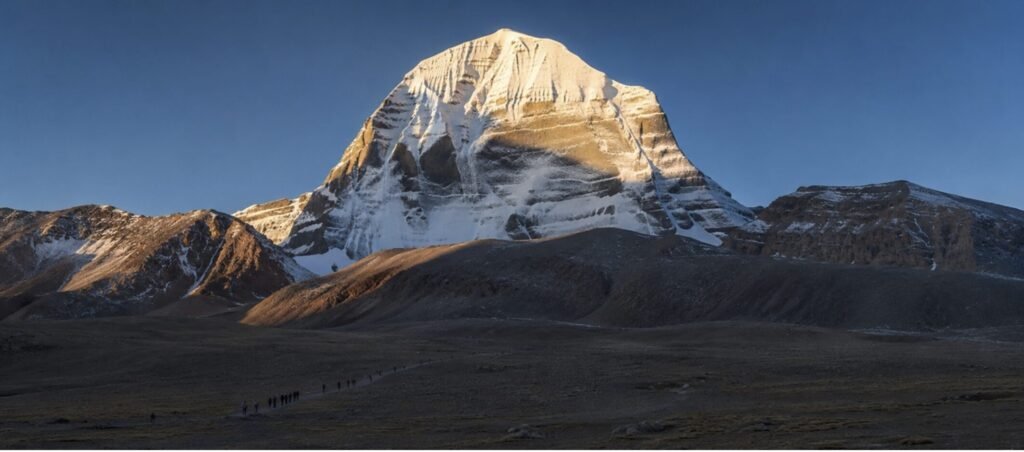
If there is one place where Saka Dawa becomes especially powerful, it is at the foot of Mount Kailash.
Tibetans call Mount Kailash Gang Rinpoche, the Precious Snow Mountain. It is sacred to Buddhists, Hindus, Bonpos, and Jains. For Tibetans, it is not a mountain to conquer, but a place to honour.
Every year during Saka Dawa Düchen, pilgrims gather at Tarboche, near Mount Kailash.
There, a tall prayer-flag pole is lowered to the ground. The old flags, faded by wind, snow, and sunlight, are removed with respect. New prayer flags in five colours are tied in their place.
Then the pole is raised again.
As monks chant and long horns echo across the valley, hundreds of hands pull together. Slowly, the prayer-flag pole rises toward the sky.
For a moment, everyone watches in silence.
The old year falls away. New prayers rise into the wind.
Why We Still Celebrate
I often think about why Saka Dawa still matters so deeply to us.
Today, Tibetans live all over the world. We are in Zürich, Toronto, New York, Dharamsala, Kathmandu, Sydney, and many other places. Many Tibetan children grow up speaking German, English, French, or Hindi more easily than Tibetan.
And yet, Saka Dawa still connects us.
It reminds us that we are still here. Our culture is still here. Our prayers, memories, and values are still alive.
The lamp my grandmother lit before sunrise was not only one small lamp in one small home. It was part of millions of lamps lit by Tibetans across the world.
Her quiet prayer was part of a much larger song, a song that has continued for generations.
Saka Dawa is one of the sacred threads that keeps us connected.
How to Walk With Us
You do not need to be Tibetan, Buddhist, or religious to understand the message of Saka Dawa.
- Light a candle one evening.
- Be gentle with the people around you.
- Give something away that you do not need.
- Walk somewhere quietly and slowly.
- Forgive someone.
- Sit for five minutes and remember that you are alive.
In the end, Saka Dawa asks something very simple from us.
Not only belief.
Not only ceremony.
But one month of living with more kindness, more awareness, and more compassion.
Tashi delek.